


Vacuum Evaporators vs. Resin Filtration
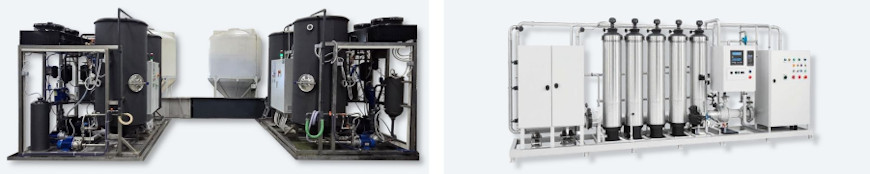
When comparing Vacuum Evaporators and Resin Filtration systems, it's important to understand their distinct purposes, mechanisms, and applications. Here's a detailed comparison:
1. Purpose and Function
Vacuum Evaporator:
Used to concentrate or separate liquids by evaporating the solvent under reduced pressure (vacuum).
Commonly used to recover solvents, reduce waste volume, or concentrate solutions.
Operates by lowering the boiling point of the liquid, allowing evaporation at lower temperatures.
Resin Filtration:
Used to remove impurities, ions, or contaminants from a liquid by passing it through a resin bed.
Commonly used in water purification, ion exchange processes, and chemical separation.
Works by adsorption or ion exchange, where the resin captures specific contaminants.
2. Mechanism
Vacuum Evaporator:
Relies on heat and vacuum to evaporate the solvent, leaving behind a concentrated solution or solid residue.
Does not involve chemical interactions; it is a physical separation process.
Resin Filtration:
Relies on chemical interactions between the resin and the contaminants in the liquid.
The resin beads have functional groups that bind to specific ions or molecules, removing them from the solution.
3. Applications
Vacuum Evaporator:
Wastewater treatment (e.g., concentrating industrial effluents).
Solvent recovery in chemical and pharmaceutical industries.
Food and beverage industry for concentrating juices or extracts.
Resin Filtration:
Water softening (removing calcium and magnesium ions).
Demineralization of water for industrial use.
Purification of chemicals or pharmaceuticals by removing specific ions or impurities.
4. Advantages
Vacuum Evaporator:
Effective for concentrating solutions or recovering solvents.
Can handle large volumes of liquid.
Environmentally friendly, as it reduces waste volume and recovers reusable solvents.
Resin Filtration:
Highly selective for specific ions or contaminants.
Can achieve high purity levels in the treated liquid.
Regenerable resins can be reused multiple times, reducing operational costs.
5. Limitations
Vacuum Evaporator:
High energy consumption due to heating and vacuum requirements.
Not suitable for separating specific ions or molecules from a solution.
May require additional treatment for the concentrated residue.
Resin Filtration:
Resins have a limited capacity and require regeneration or replacement.
Not effective for non-ionic contaminants or large-scale solvent recovery.
Can be costly for large volumes or highly contaminated solutions.
6. Cost Considerations
Vacuum Evaporator:
Higher initial capital cost due to complex equipment.
Operational costs include energy for heating and maintaining vacuum.
Resin Filtration:
Lower initial cost but ongoing expenses for resin replacement or regeneration.
Operational costs include chemicals for resin regeneration (e.g., acids, bases).
7. Environmental Impact
Vacuum Evaporator:
Reduces waste volume and recovers solvents, making it environmentally beneficial.
Energy-intensive process may contribute to a higher carbon footprint.
Resin Filtration:
Environmentally friendly for water purification and ion removal.
Disposal of spent resins and regeneration chemicals can pose environmental challenges.
Summary
Use a Vacuum Evaporator if your goal is to concentrate solutions, recover solvents, or reduce waste volume.
Use Resin Filtration if your goal is to remove specific ions or contaminants from a liquid to achieve high purity.
The choice between the two depends on the specific application, desired outcome, and operational constraints. In some cases, both technologies may be used in tandem for comprehensive treatment.