


Vacuum Evaporator Vs. Reverse Osmosis
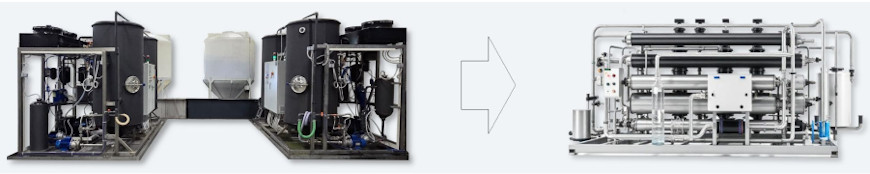
Both vacuum evaporation plants and reverse osmosis (RO) systems are used for water purification and concentration processes, but they operate on different principles and have distinct advantages and disadvantages. Here are some advantages of a vacuum evaporation plant when compared to reverse osmosis:
1. Handling High TDS and Viscous Liquids
Vacuum Evaporation: Can effectively handle liquids with very high Total Dissolved Solids (TDS) or viscous solutions that would clog or damage RO membranes.
RO Limitation: RO systems struggle with high TDS or viscous fluids, as they can cause membrane fouling, scaling, or reduced efficiency.
2. No Membrane Fouling
Vacuum Evaporation: Does not rely on membranes, so there is no risk of fouling, scaling, or clogging, which are common issues in RO systems.
RO Limitation: Membranes in RO systems are prone to fouling, scaling, and degradation, requiring frequent cleaning, maintenance, and replacement.
3. Higher Concentration Levels
Vacuum Evaporation: Can achieve much higher concentration levels, making it suitable for applications like brine concentration, zero liquid discharge (ZLD), or recovering valuable solids.
RO Limitation: RO systems have a limited concentration factor and cannot achieve the same level of concentration as evaporation.
4. Better for High-Temperature or Heat-Sensitive Applications
Vacuum Evaporation: Operates under reduced pressure, lowering the boiling point of water and allowing gentle evaporation of heat-sensitive materials. RO Limitation: RO operates at ambient temperatures and may not be suitable for heat-sensitive applications or those requiring thermal treatment.
5. Effective for Complex Wastewater
Vacuum Evaporation: Can process complex wastewater streams containing oils, fats, or organic compounds that would damage RO membranes.
RO Limitation: RO systems are less effective for wastewater with high organic content or oils, as these can foul the membranes.
6. Zero Liquid Discharge (ZLD) Capability
Vacuum Evaporation: Ideal for ZLD applications, as it can completely evaporate water and leave behind solid residues.
RO Limitation: RO alone cannot achieve ZLD; it typically requires additional processes like evaporation or crystallization.
7. Lower Sensitivity to Feedwater Quality
Vacuum Evaporation: Less sensitive to variations in feedwater quality, making it more robust for fluctuating or challenging feed conditions.
RO Limitation: RO systems require pre-treatment to remove suspended solids, organics, and other contaminants to protect the membranes.
8. Longer Equipment Lifespan
Vacuum Evaporation: Generally has a longer lifespan with fewer maintenance requirements compared to RO systems, which require frequent membrane replacement.
RO Limitation: Membranes have a limited lifespan and need regular replacement, increasing operational costs.
9. Energy Efficiency in Certain Applications
Vacuum Evaporation: Can be more energy-efficient for high-concentration applications or when waste heat or steam is available.
RO Limitation: RO systems are energy-intensive for high-TDS feedwater, as they require high pressure to overcome osmotic pressure.
10. Flexibility in Design
Vacuum Evaporation: Can be designed for batch or continuous processes and tailored to specific industrial needs.
RO Limitation: RO systems are typically designed for continuous operation and may not be as flexible for certain applications.
Summary:
Vacuum evaporation plants are particularly advantageous for applications involving high TDS, complex wastewater, ZLD, or heat-sensitive materials. They avoid the membrane related issues of RO systems and can achieve higher concentration levels. However, the choice between the two technologies depends on the specific application, feedwater characteristics, and operational requirements. In some cases, a combination of both technologies may be the most effective solution.